

By Sue Bradford
In March 1994 a group of adult educators, union and community organisers, Catholic social justice advocates and Pākehā treaty activists came together to develop what was first conceived as a ‘school for social change’.
Inspired by the examples of the folk schools of Scandinavia and by the Highlander School in Tennessee we wanted to build our own ‘school’ where techniques of participatory adult education would be used to support community action for a more just world. As far as we could identify there was nothing like this in Aotearoa at that time. From 1994 onwards we worked to establish what became by 1996 a charitable trust, ‘Kōtare Research and Education for Social Change’. Early trustees included people like John Benseman, Katherine Peet and Claire-Louise McCurdy who had close associations with the Workers’ Educational Association (WEA) and others who came from church, community and activist backgrounds, including Tim Howard, Josie Lander, Quentin Jukes, Karen Davis, Sr Noelene Landrigan and Bill and Sue Bradford.
We sought inspiration and guidance from the teachings of Paulo Freire and educators like Frs Felipe Fanchette and John Curnow who brought the tools of Freirean structural analysis to Aotearoa in the 1980s. Other influences included experiences working alongside tangata whenua rōpu in various struggles, experiential learning in the early days of the Pākehā treaty education movement, grassroots union and community organising, and a hearty appreciation of the benefits of incorporating cultural and creative work into pedagogical practice.
The first big step we took was to establish a physical base from which to operate. In 1997 we bought three classrooms from the Manukau Technical Institute (now MIT) and relocated them on a hectare of rural land at Hoteo North, near Wellsford. Autonomy and the ability to hold kanohi ki te kanohi residential workshops over two or three days on our own terms were key goals at a time when New Zealand’s community sector was becoming increasingly colonised in a changing funding and contracting environment.
The second breakthrough came in 1999 when we finally raised enough money to employ our first education coordinator – writer, anti-mining activist and educator Catherine Delahunty. Our first official Kōtare workshop took place in Whaingaroa/Raglan in June 1999 with a two-day programme aimed at strengthening the work of local tangata whenua and tauiwi on sewage issues around the harbour.
Relationships with tangata whenua are integral to our being. We were welcomed to the land at Hoteo North at the time of our formal opening and blessing in 1999 by people from Ngāti Whātua o Kaipara and Te Uri o Hau, and we continue to value our relationships with whānau locally.
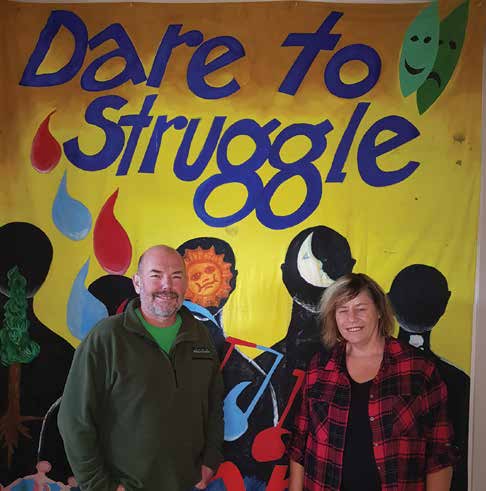 Over the two-plus decades of our existence, Kōtare has run hundreds of workshops and welcomed thousands of participants, mostly to our base at Hoteo North, but at times to programmes run in other localities as well. Thematic areas have included climate justice and natural resource protection; youth, women, faithbased, union, unemployed and beneficiary and housing organising; cultural work (using creativity for community-building and social action); Pākehā Tiriti education and the role of allies; disability activism; LGBTIQA+ activism; and community economic development.
We also run workshops on various aspects of the pedagogy of adult participatory education, including the use of structural analysis, economics as if people and planet mattered, community-based archiving and history/storytelling, and groupbuilding, facilitation, campaigning and other organisational and capacity-building skills.
Two years of Covid has affected us deeply. Only sporadically have we been able to operate in our preferred residential mode. Like many groups we have been obliged to go online, doing our best to maintain a participatory element despite the constraints of Zoom. Recent workshops have included: a series Building Relationships, Common Analysis and Hope; a short online course for social and ecological practitioners and community activists What’s Facing Us as We Head into 2022?; Contextual Analysis; and Organising with Social Change in Mind. Our two most recent sessions undertook collective analyses of the nature, drivers and implications of the anti-mandate protests, something many people are still trying to get their heads around.
Kōtare has always consciously seen itself as part of the ACE sector. In earlier days we were active in conferences and hui, and from 2005–2011 we were recipients of TEC funding which enabled us to offer an expansive range of programmes. We shared the heartbreak of many other rōpu when changes in policy under National meant all support was withdrawn from groups who failed to meet new constrained criteria. By 2013 we were obliged to make our two paid workers redundant, never the happiest moment in a community organisation’s history. It wasn’t until 2017 that we were able to take on a paid part-time worker once more.
Kōtare has only been sustainable because of the dedication of a highly committed volunteer workforce. Trustees have always played an integral role as facilitators, educators and occasional researchers, as well as helping with the physical work of maintaining the buildings and land. Those at the core are backed by a wider whānau whose commitment to regular automatic payments provides an income that enables us to keep paying the bills. Our supporters are also great at turning out for working bees where they do a champion job with essential tasks like painting, weeding, planting and cleaning, always followed by a slap-up lunch. Good healthy kai has its place at the heart of all our activities.
Other funding sources over the years have included COGS and a number of charitable trusts. In recent times a comparatively generous grant from Foundation North is helping support the all-important task of transition beyond Kōtare’s founding generation.
Those of us who were there at the beginning said at the time that we wanted this group to be one that outlasted our lifetimes. We’re not quite there yet, but are dedicated to doing everything we can to make it happen by creating opportunities for intergenerational dialogue and the recruitment of younger generation trustees and educators.
Catherine Delahunty attended the ACE Conference in June 2018 where one of the speakers was Peruvian popular education leader Nélida Céspedes Rossel. In an article Catherine wrote for Nélida after the conference about the influence of Paulo Freire in Aotearoa she says ‘So many of Freire’s ideas from praxis to rejecting ‘neutrality’ have helped us to co-construct educational experiences with both adults and younger people that have increased activism and solidarity. Although popular education has been undermined by freemarket economics, the commitment to justice at the heart of our collective learning cannot be destroyed.’
In 2020–2021 Kōtare carried out an impact survey among workshop participants. Key findings included:
- The decision made very early on to provide (mostly) residential education was thoroughly vindicated by people’s responses around the importance of space, place, food, relationships and ritual to the kind of educational experience Kōtare offers.
- Kōtare remains an outlier in adult and community and adult education, at least among Tangata Tiriti organisations.
- Kōtare is recognised for its role modelling as a Pākehā organisation striving to operate in a way that is grounded in Te Tiriti, but is not solely focused on treaty education itself, and which also seeks to involve tangata whenua, tagata Pasifika and all tauiwi, including recent migrants.
- Despite a lack of access to steady or institutional funding, Kōtare has held firmly to the integrity of its original kaupapa.
Kōtare continues to do its best to offer hope, and a place to stand.
If you are interested in finding out more: website: kotare.org.nz
Or email: education@kotare.org.nz