
Mad Ave is a whānau development organisation based in Glen Innes. It is named after Madeleine Avenue, an iconic street in that East Auckland suburb.
They call their development approach He Whainga Mahara, which is based in the three baskets of knowledge: Tika – integrity and order; Pono – authenticity and clarity; and Aroha – compassion and care.
The trust was established around 15 years ago by the whānau of Janette aka Skippy Patuwai.
Skippy had recently retired as a social worker and wanted to support her community using a more localised way of support, so her whānau set up a community trust. Sadly Mrs Patuwai died, and it was left to her children to bring Mad Ave into being.
Tamati Patuwai who is one of Skippy’s sons says that wairua or spirituality is at the heart of everything they do “because it is intrinsic to our indigenous world view.”
 “Our ancestors are right here with us. Their mana, their practices that bore fruit and creativity is what we focus on. Spirituality is often side-lined to religious spaces and is not seen as a mainstream function of community development. But it is our ancestral wisdom that helps people grow – not in a way that is self-centred, but community-centred. Everything is related and although it is complex, for us it just makes sense. We sit in an ecology of beings, the mountains, the rivers and the trees, as well as with our elders and children. If we don’t have wairua and aroha for our environment, our people, and also for our-selves, we are like a waka without a rudder. We might have some great ideas to help our communities but if we don’t have that spiritual lens, then the fuel of that initiative will run out in time.”
Mad Ave has been intentionally kept small so they are not tied down by top-heavy, long-term contracts but remain agile and able to respond to issues as they arise. They know their community well. Glen Innes and Panmure have a population of around 17,000 and a relatively significant proportion of those people are Māori and Pasifika. Tamati’s whānau have long lived in this community. They are connected, and they know how to listen. So quick were they to get the required outcomes in one short Ministry of Education contract, that staff were sent to find out how it was done. “We have a deep understanding of these people,” says Tamati, “we come from the same place, we have the same history. We know them and they know us. We trust they know what they want and need, and they know how to do it. Trust is pivotal. All we try to do is to provide the environment for them to do the work. Trust clears the space of any barriers.”
At the moment Mad Ave has several main projects: T.A.O, a rangatahi leadership programme; Mad Ave Whānau, working with whānau and local ECE providers supporting pathways into early childhood learning; Mana Wahine, a women’s empowerment platform; the Omaru Restorative Action Programme, working with the community to connect to their environment and local river; and Home Fires, a community-led research project supporting whānau whose homes are being lost as state housing initiatives take away old homes and build new ones. The emphasis is to bring a community led voice to the property decision-making table.
This article focuses on the rangatahi leadership programme.
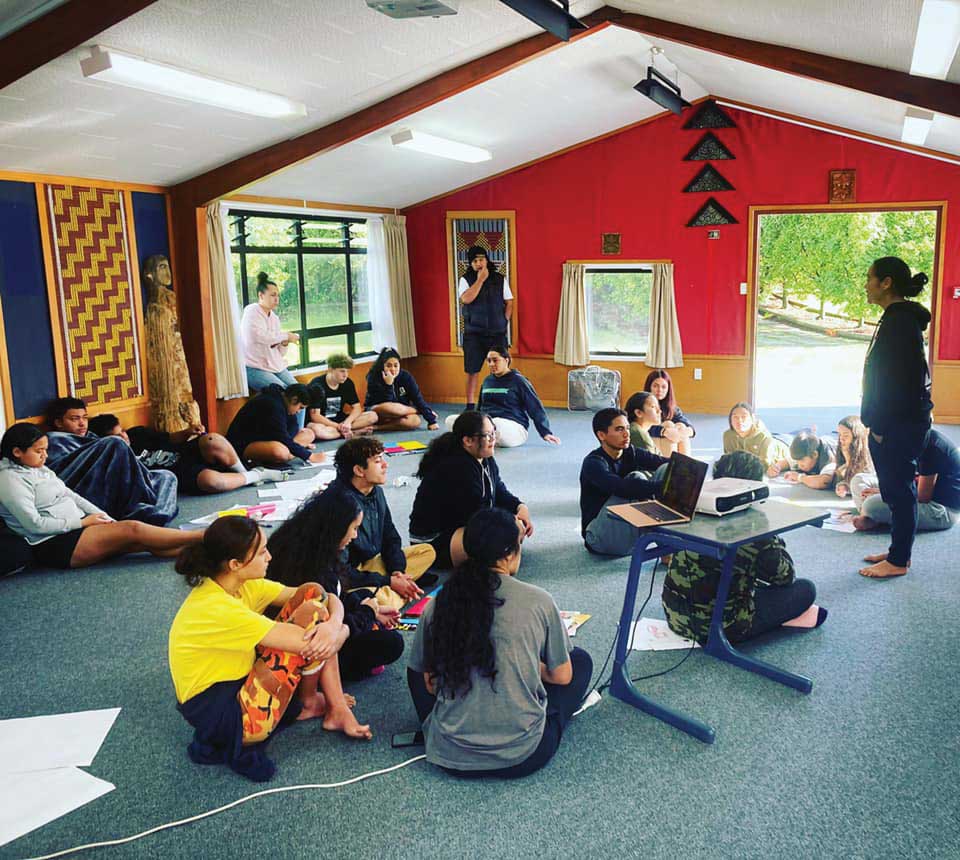
Although Mad Ave is not a youth organisation, it engages a lot with young people. They employ them as project leads and researchers so that they can get in amongst the issues. They support learning by doing, and self-care. Their leadership programme is about the mental, emotional and spiritual wellbeing of rangatahi. Unfortunately suicide is a major concern.
 “We know that our youth are inundated with life stresses and are not getting enough self-care support and focus in their lives,” says Tamati. “So in our leadership training we actually attempt to flip the idea of what leadership might be.
“The tendency is to think of a leader as someone who is at the front, making a lot of good noises, so therefore we are attracted to what they say and we follow them. Which is great. But we encourage the rangatahi to think broadly and to see themselves as already being leaders wherever they are positioned. With the right guides in place anything you want to do and how you want to go about it, can be full of leadership qualities.
“We asked a young Māori woman what leadership meant to her. She told us that it is being able to provide kai for my whānau for when they hui on my marae. Wo! That is leadership. Providing for your people is leadership. You may be behind the scenes, and not even seen but you are serving, which for us is absolutely leadership. In fact some of the most powerful leaders for us are incredibly humble and don’t want notoriety in any way. They just get it done.
“We sprinkle these ideas throughout the wānanga with the youth, so that we can normalise what it means to be a spiritual person, to be a functioning part of a family, to be a citizen. We guide them to understanding these things.
“We share with them that when our ancestors talked about tino rangatiratanga they were declaring that we must work to be the fullest and most capable human beings that we can be. That we become ambassadors. That’s what citizenship really is. Someone giving as well as receiving, and who is deeply engaged in their community in some way. We want to free up the sense of who we can become. Not passive recipients of care, but active, accountable contributors to our own wellbeing. This alone is tino rangatiratanga, and for us in today's world, revolutionary.”
The leadership programme supports about 50 rangatahi over a year. They meet monthly, and all are supported to develop their own life vision which is filled with what they want to be doing. They set up vision pathways and timelines. A big part of this is to deal effectively with the barriers and stuck spots. Many have breakdowns in their closest relationships with their parents, siblings and close circles. They are provided with the tools to restore those relationships. During the programme they learn personal life skills that build towards educational and employment goals. If a young girl wants to be a designer, they put her in touch with the right tertiary institution, or if someone wants to go into hospitality, they help make that happen. They wrap around the support mechanisms and specialists that bring those future goals closer to reality.
 The whole approach is youth-centric and rangatiratanga focussed.
“When we work with young people,” says Tamati, “we work within their youth culture. They are always teaching us about their own vision and desires and as much as possible we try to deliver the programme in ways that are relatable and relevant. This is why a good chunk of how we deliver our T.A.O project is in a blended format, with live training and wānanga as well as online features. Culture, art and creativity is a big part of what we do and how we do it.”
A few years ago Professor Ella Henry from AUT helped deliver, a Mad Ave leadership programme for young Māori women. She is a long-term friend and supporter of Mad Ave. We asked her how the organisation is using tikanga and mātauranga Māori for transformation and wellbeing. She told us a story.
“I was invited to a pōwhiri for a street which had experienced devastating changes, where people had to leave old family homes and move into better houses where there were people they did not know. Everyone was welcomed onto the street, onto the whenua in a very Māori way. People all came out of their houses. Often it can take years to get to know your neighbours, but the tikanga of shared food, shared stories of origins, telling people who you are was one of the most beautiful examples of a pōwhiri that I have ever seen. They brought pōwhiri into a contemporary setting – not a big formal initiative. It was confirmation of the extraordinary strategic thinking of Mad Ave. I have a very high regard for their work. I just love what they do.”